How Long The Tongariro Crossing Takes On A Guided Hike Day
The Department of Conservation puts the Tongariro Alpine Crossing at 7 to 8 hours of walking from November to April and 9 hours from May to October, over 20.2 km one way. A booked tour day runs longer than the walk itself, and the difference matters when you are choosing between a shuttle and a guided hike.
Short answer
DOC says the Tongariro Alpine Crossing takes 7 to 8 hours to walk from November to April and 9 hours from May to October, over 20.2 km one way. A booked day runs longer: the Adrift premium guided hike spans 8 to 9 hours door to door, and the Tongariro Crossing Shuttles round trip is booked as an 8 hour day.
How Long Does The Tongariro Alpine Crossing Take?
The Department of Conservation gives the Tongariro Alpine Crossing a walking time of 7 to 8 hours from November to April and 9 hours from May to October, over a distance of 20.2 km one way. Those figures describe time on the track only. A booked tour day wraps transport around the walk, which is why guided and shuttle products are quoted as 4 to 10 hour days depending on the tour.
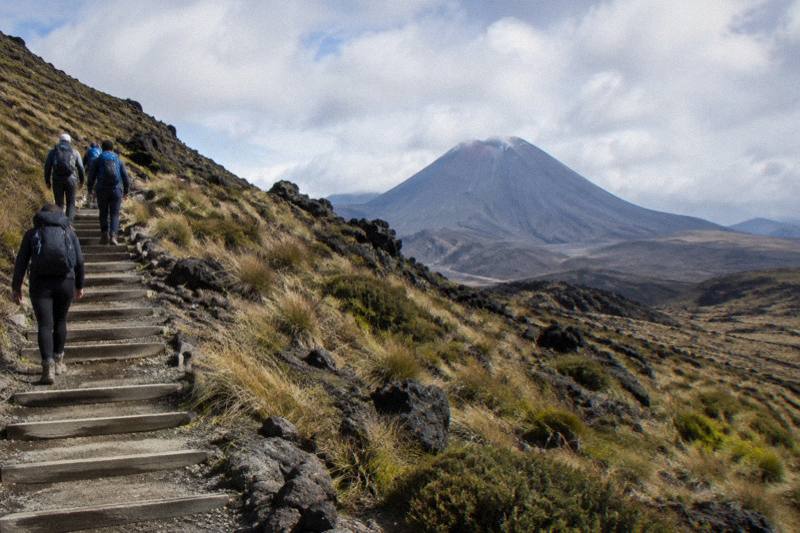
That 7 to 8 hour summer figure is the walking time for the full one-way route from Mangatepopo to Ketetahi. DOC grades the track as High fitness, steep and undulating, with an elevation change of plus and minus 1196 m. The walk starts at 1120 m at Mangatepopo, tops out at Red Crater at 1886 m, and finishes at Ketetahi Road at about 760 m. So the day is not a simple climb: you climb to the South Crater plateau, climb again to Red Crater, then descend a long northern flank to the road end.
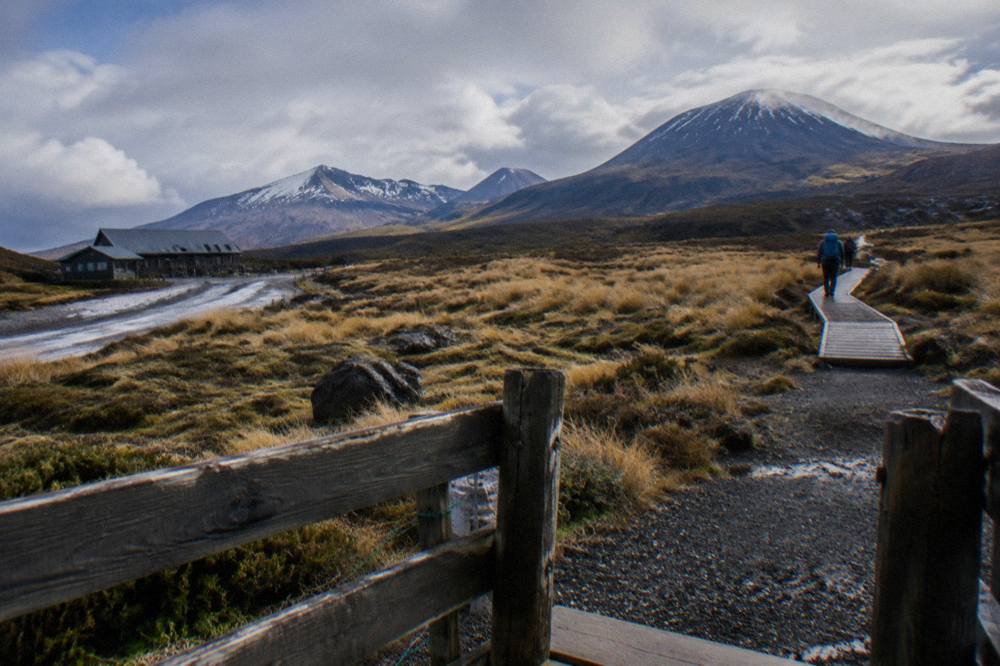
Winter changes the arithmetic in two directions at once. The track becomes an Expert route under snow and ice, which is why DOC's winter guidance says to allow 9 hours, and the daylight window shrinks to between 9 and 11 hours. That leaves almost no slack, which is why DOC's winter advice is blunt: always take a head torch, carry the alpine kit, and be ready to turn back. The full winter picture, including the gear DOC calls essential, is covered in the section on winter timing below.
| Season | DOC walking time | Track category | Daylight consideration |
|---|---|---|---|
| November to April | 7 to 8 hours | Intermediate tramping track | Long summer days give margin |
| May to October | 9 hours | Expert route | 9 to 11 hours of daylight, head torch advised |
The seasonal figures come straight from DOC's Tongariro Alpine Crossing track page, which is also where seasonal alerts are posted. Nothing on this page can promise the track is open on any given day: operators have agreed, as part of their concessions, not to operate when a Hazardous Weather Warning has been issued, so treat every timing plan as conditions allowing.
Walking Time Versus Total Tour Day Length
Walking time and booked duration are different numbers. The walk itself is 7 to 8 hours in the summer season, but tour products quote the whole day: the Adrift Tongariro premium guided Crossing hike is an 8 to 9 hour booked day, the Tongariro Crossing Shuttles round trip is booked as 8 hours, and Tongariro Expeditions options span 8 to 10 hours. Build your schedule around the booked day, not the track time.
The gap between the two figures is transport and logistics, not padding. A round-trip shuttle collects you in the morning, drives you to the Mangatepopo end, waits while you walk, and brings you back from Ketetahi in the afternoon. A guided day adds a briefing, gear checks and a group pace that keeps everyone together. None of that appears in DOC's 7 to 8 hours, and if you book an early dinner table in Taupo that same evening you are gambling on a descent, a shuttle queue and an 86.5 km drive back down the lake.
| Tour | Format | Booked day length | From price (USD) |
|---|---|---|---|
| Adrift Tongariro premium guided Crossing hike | Guided full Crossing | 8 to 9 hours | From $253 per person |
| Adrift Tongariro private guided Crossing | Guided private | 7 to 9 hours | From $774.01 |
| Adrift Tongariro half-day guided walk | Guided short walk, not the full Crossing | 4 hours | From $197 per person |
| Tongariro Crossing Shuttles round trip | Shuttle, round trip | 8 hours | From $42 per person |
| Ruapehu Scenic Shuttles Ketetahi park-and-ride | Shuttle, one-way | 8 hours | From $38 per person |
| Active Outdoor Adventures secure car park shuttle | Shuttle, one-way | See booking page | From $34 per person |
| Tongariro Expeditions shuttle options | Shuttle, several options | 8 to 10 hours | From $42 per person |
| Tongariro Expeditions Taupo return shuttle | Shuttle, round trip | 10 hours | From $80.27 per person |
Note the two prices printed without a per-person basis. The Adrift private Crossing and the ExperienceKart three-day tour show prices on the live booking page with no per-person figure, so they sit outside per-person comparisons entirely. Among the per-person tours, the dearest is the Adrift premium guided hike priced from $253, and the cheapest per person is from $34, a one-way park-and-ride shuttle. Reading the table, the pattern is simple: the more transport and guiding wrapped around the 20.2 km, the longer and dearer the booked day.
If you are weighing a guided day against a shuttle day, the choice is really about how much of the clock you want to hand to someone else. A shuttle day is your own walk with transport at each end. A guided day is the walk plus a guide, gear provision in winter and a group pace set for the whole 20.2 km.
How Early Does A Tongariro Tour Day Start?
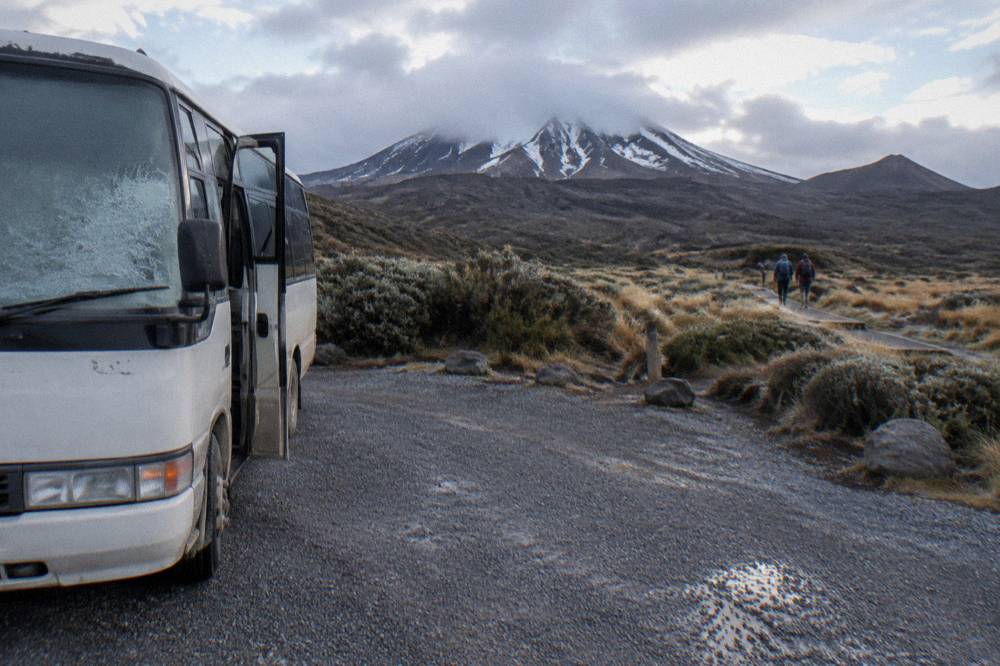
Every practical plan for the Crossing involves an early start, and DOC's own parking rules push in the same direction. From Labour weekend in late October to 30 April a 4 hour maximum applies at the Mangatepopo and Ketetahi road ends, and DOC suggests booking a shuttle rather than parking. In summer there is no parking for Crossing walkers at Mangatepopo car park at all, with only a private car park near the Ketetahi end.
The early start is not a suggestion from operators, it is arithmetic. With 7 to 8 hours of walking and a descent that finishes at a road end, walkers want to be stepping off the shuttle at Mangatepopo with the whole day in front of them. Operators run to that reality, and DOC assesses the day's weather advisory each morning against the NIWA Red Crater forecast, so shuttle and guided days are shaped around a morning decision made before the walk begins. Departure timetables vary by operator and season; the operator's booking page shows the schedule for your date.
The booking system sits on top of the parking rules. A track booking, free since October 2023, is required to use a shuttle or guided walk service, is recommended for everyone, and carries no penalty if you arrive without one. One booking covers a group, you show the receipt to rangers at the carpark, and a guide or shuttle operator may make the booking for you. The detail is worth a read of the dedicated booking guide for the Crossing, which walks through the system step by step.
Parking strategy is a topic in itself, and if you are set on bringing your own car the car park versus shuttle comparison lays out the park-and-ride pattern: six one-way products have you park at the Ketetahi end, ride to Mangatepopo and walk the Crossing back to your own car. The Tongariro Crossing Shuttles round trip from National Park Village takes the opposite shape, a Park n Ride start at 59 Findlay Street with a morning pickup and an afternoon return from Ketetahi, rated 4.7 across 886 reviews and from $42 per person, with free cancellation up to 24 hours before. You can check the round-trip shuttle day alongside Dempsey Buses Round-Trip Shuttle when you know your dates.
Does Fitness Change How Long The Crossing Takes?
Yes, materially. DOC grades the fitness requirement as High over steep and undulating ground, and advises the track is not recommended for children under 10. Strong walkers finish the summer Crossing near the bottom of the 7 to 8 hour range; slower parties, photo stops and tired knees on the long descent push toward the top of it or beyond.
The shape of the track explains most of the spread. From Mangatepopo the first 5.4 km is shared with the Soda Springs Walk, an easy 2 hour return option, and it goes gently. Then comes the steady climb of around 350 m up the staircase to the South Crater plateau, the ascent to Red Crater at 1886 m, and a steep scree descent on loose rock that DOC flags as a major slip hazard. Many steps on the northern descent can trouble weaker knees, and that final flank is where most of the time penalty for tired legs is paid.
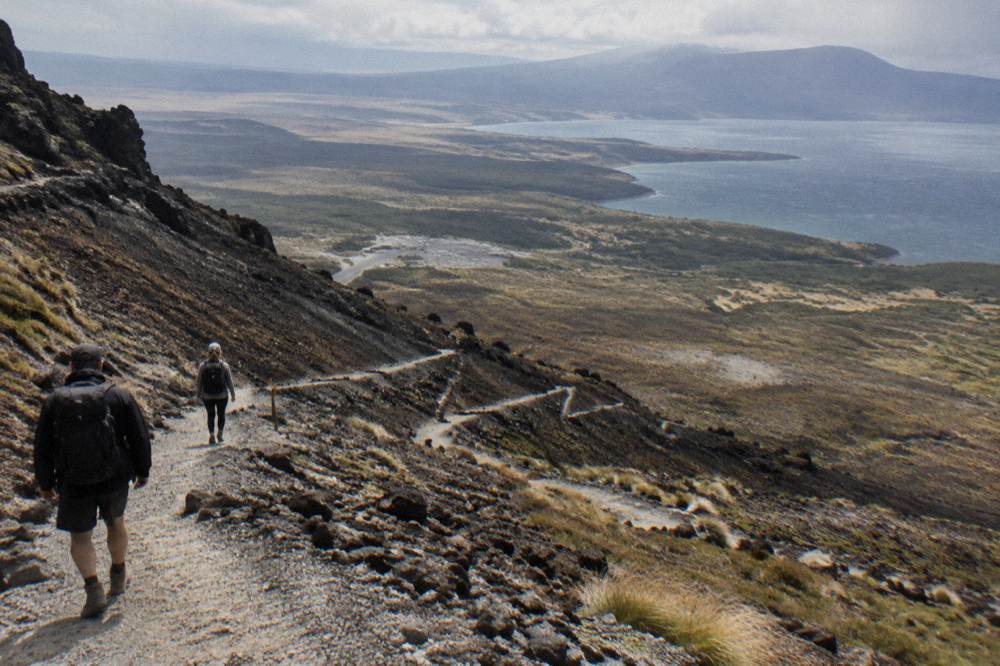
Fitness questions come up constantly for this track, and the honest answer about preparation is gathered in how fit you need to be for the Crossing. The short version: if 7 hours of continuous hill walking sounds like a stretch, a guided day absorbs some of that pressure, because a guide sets a sustainable group pace and manages the schedule. The Adrift Tongariro premium guided Crossing hike runs 8 to 9 hours as a booked day, is rated 4.6 across 241 reviews, and takes walkers from age 12 in groups of up to 60, from $253 per person with return transport included and free cancellation up to 14 days before.
Toilets sit every 1 to 2 hours along the track, and DOC notes that if there is a queue at Mangatepopo the next toilets are 1 km, about 20 minutes, further on. Budget for those stops. The gap between a 7 hour moving estimate and an 8 hour day on the ground comes down to breaks, layer changes and photographs at the craters.
How Long Does The Crossing Take In Winter?
DOC says allow 9 hours from May to October, when the track is an Expert route over snow and very icy sections, with only 9 to 11 hours of daylight. Winter walking is a different discipline: crampons, ice axe and helmet are essential, as is competency using them, and DOC's own summary advice for the season is to go with a guide.
The winter clock is tight enough that every hour is spoken for. Beyond the 9 hour allowance, DOC expects ice on the track between April and October, lists an avalanche transceiver, probe and shovel among the essentials for independent trips, and points to the avalanche forecast at avalanche.net.nz as required reading. Slipping is the dominant hazard: 38 percent of tramping injuries come from slips, and DOC publishes a working temperature rule for the summit, on a calm day Red Crater is at least 10 °C colder than Taupo and 5 °C colder than the track start, subtracting another 2 °C for every 10 km/h of wind.
Two structural facts shape winter planning more than any timetable. Shuttle buses generally do not operate in winter, DOC says, while guided trips include transport. And no hazardous weather advisories are issued from May to October, so reading the forecast yourself, MetService mountain forecast and NIWA's Red Crater forecast, replaces the summer advisory system. The winter season detail, including what a guided winter day covers, is laid out in the winter guided tour guide.
Adrift Tongariro runs the three guided tours here across summer and winter alike, and on winter dates the premium and private Crossing tours supply crampons and ice axes if conditions require them, plus a clothing and footwear allowance, with lunch to bring yourself since food is not included. The difficulty guide for the Crossing compares the two seasons section by section if you are deciding which one to book.
Where Does The Time Go On The Track Itself?
The 7 to 8 summer hours are not evenly spread over the 20.2 km. Roughly the first quarter, 5.4 km shared with the Soda Springs Walk, is gentle valley walking; the middle third holds the two big climbs, the 350 m staircase to South Crater and the push to Red Crater at 1886 m; and the whole northern side is a long zig-zag descent to the road end at 760 m.
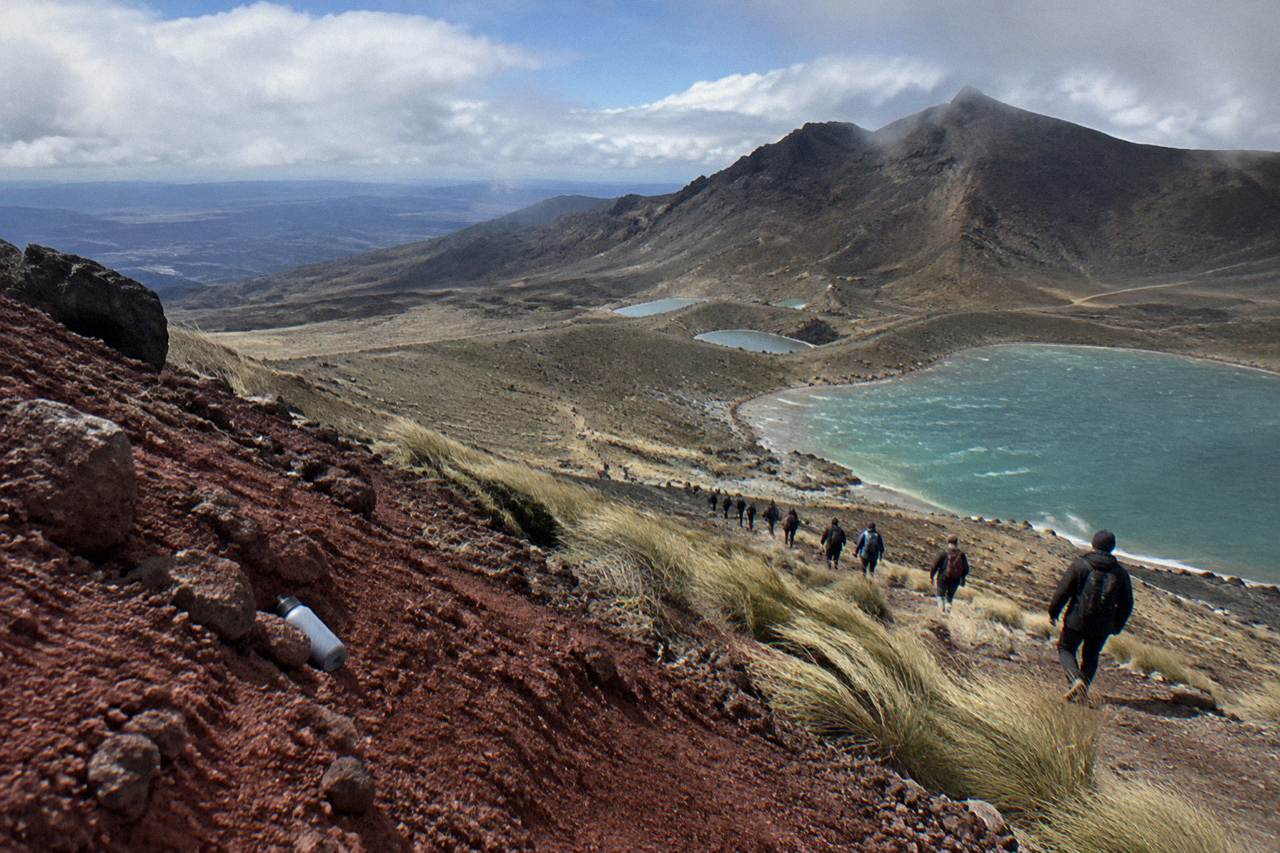
DOC's own route description reads like a timeline of the day. A boardwalk carries you through Mangatepopo Valley, the staircase delivers you onto the South Crater plateau, and Red Crater's loose scree comes next as both the high point and the most technical footing of the walk. Below it sit the Emerald Lakes, Ngā Rotopounamu, where fumaroles vent steam and DOC asks walkers not to approach, then Blue Lake, Te Wai Whakaata o Te Rangihīroa, before the northern slopes open views over Lake Rotoaira and Lake Taupō and the track drops through forest to Ketetahi Road.
One cultural request belongs in the timing conversation, because it costs nothing and guides where you stop. Ngati Hikairo ki Tongariro ask visitors to respect the sacred mountains by not touching or entering any of the waterways, including the alpine lakes. The lakes are for looking at, and the photographs are the better for the restraint.
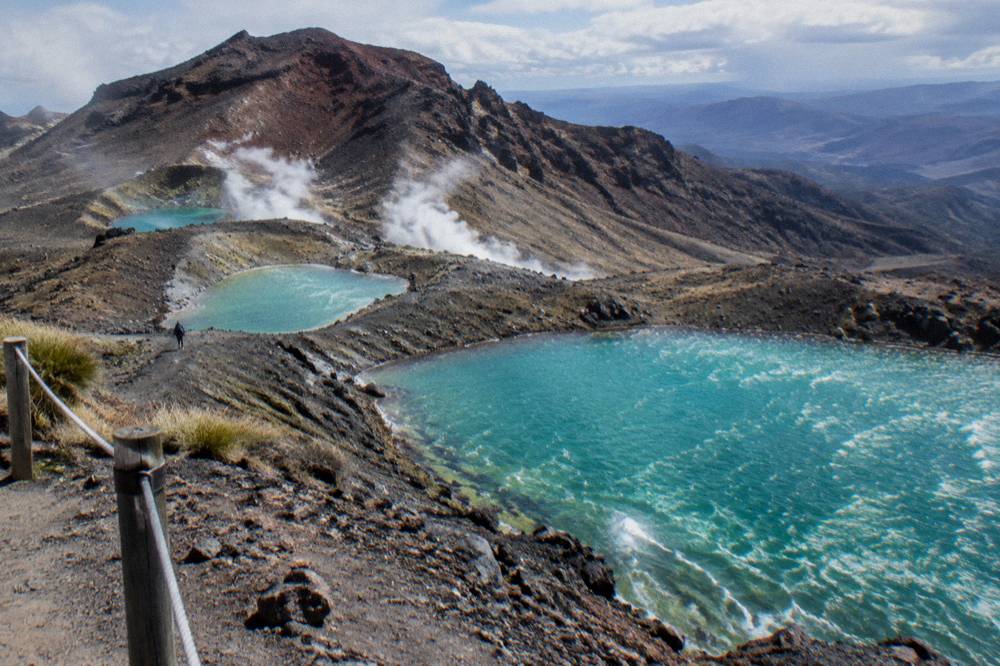
Late 2025 fires burned significant areas of the park around the start of the Crossing, and blackened landscapes with regrowth now line the early kilometres. Ngati Hikairo ki Tongariro placed a 10-year restorative rāhui over the affected area, explained by the hapū as not about keeping people out: the ask is to stay on the track, keep out of fire-affected areas off track, clean shoes and gear, and take rubbish home.
| Track section | What dominates the time |
|---|---|
| Mangatepopo Valley, first 5.4 km | Gentle boardwalk shared with the Soda Springs Walk |
| Devil's Staircase to South Crater | Steady 350 m climb on steps |
| South Crater to Red Crater | Ascent to 1886 m, exposed and weather-sensitive |
| Red Crater to Emerald Lakes | Steep scree descent, loose rock slip hazard |
| Emerald Lakes to Ketetahi Road | Long zig-zag descent, steps that tire knees |
Can You Shorten The Day If Time Is Short?
Yes, in two ways. The first 5.4 km doubles back as the Soda Springs Walk, an easy 2 hour return option DOC names for people without the fitness for the full crossing. And a guided short walk exists: the Adrift Tongariro half-day guided walk is a 4 hour booked day from $197 per person, rated 4.7 across 27 reviews, and it is a shorter volcanic walk, not the full Crossing.
The half-day option matters for itineraries that cannot absorb an 8 hour day, a late travel day, a family with a younger walker, or a recovery day between bigger efforts. It starts from the Adrift base at 53 Carroll Street in National Park Village, includes return transport and a guide, runs summer and winter with gear supplied if conditions require, and carries free cancellation up to 14 days before. What it does not do is deliver Red Crater and the Emerald Lakes; the booking page is explicit that this is a shorter walk.
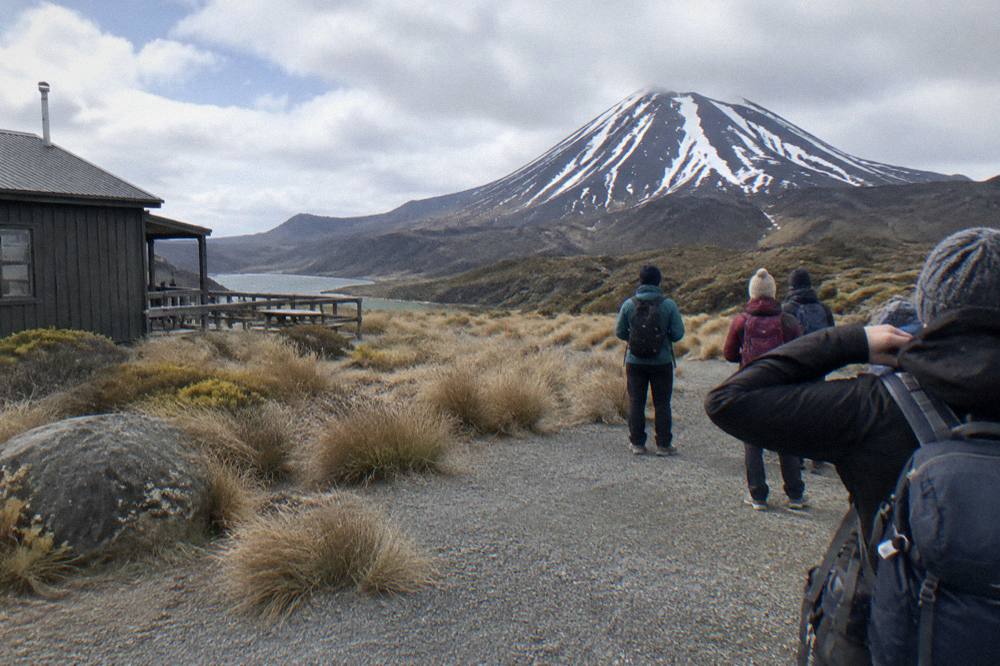
For independent walkers caught by weather or legs, DOC names two alternatives in poor conditions: the Taranaki Falls Walking Track and the Tama Lakes Track. Neither is a substitute for the Crossing's crater country, but both keep a mountain day alive when the advisory signage at the Mangatepopo Road end says the full track should wait. If the shortened-day question is really a which-tour question, the Dempsey Buses round-trip shuttle from National Park Village is a tighter shuttle alternative to the bigger round-trip products, from $51 per person, rated 4.8 across 72 reviews, with a morning pickup from pickup points in National Park Village and an afternoon return from Ketetahi, free cancellation up to 24 hours before.
How Should You Plan The Rest Of The Day Around The Walk?
Treat the Crossing as the whole day and plan nothing before an early start or within the booked day length. Base yourself within DOC's distances of the track, Whakapapa at 10.4 km, National Park at 13.5 km, Turangi at 36.7 km, Ohakune at 48 km, Taupo at 86.5 km, and give the evening to recovery rather than a second activity.
The distances come from DOC's getting-there guidance, and they map neatly onto the shuttle categories. National Park Village carries the round-trip shuttles and the Adrift guided base. The Ketetahi end carries the six one-way park-and-ride products. Taupo, Turangi and Ohakune feed the longer shuttle days, the Tongariro Expeditions Taupo return shuttle is a 10 hour booked day, which tells you plainly that the lake city is a commitment for this walk.
Where you sleep decides how the day feels. A village base turns the Crossing into a short shuttle hop and an afternoon nap; a Taupo base turns it into the 10 hour round trip the tour durations already advertise. Neither is wrong, but the booked day length on each product, 8 hours for the Tongariro Crossing Shuttles round trip, 8 to 10 hours for the Tongariro Expeditions options, is the honest planning number, not DOC's walking time alone.
If the whole question is new to you, Tongariro Alpine Crossing Tours gathers every departure point and tour type on one site, so you can match the day length to the rest of your itinerary before you commit. Choose the tour whose clock fits your holiday, not the one whose price alone looks friendliest.
Whichever product you settle on, hold the plan loosely. Operators do not run on hazardous-weather-warning days, and the advisory is assessed each morning in season, so the booking terms matter as much as the timetable. Every round-trip shuttle named here carries free cancellation up to 24 hours before, the Adrift premium and half-day guided tours up to 14 days, while the Adrift private Crossing is non-refundable, a difference worth weighing before you book a date far in advance.
How Does The Elevation Profile Change The Clock?
The Crossing does not spread its effort evenly. DOC puts the start at 1120 m at Mangatepopo and the high point at Red Crater, 1886 m, before the track drops to finish at Ketetahi Road at 760 m, with an overall elevation change of plus and minus 1196 m. Almost all of that climbing is compressed into the middle third of the day, first up a staircase to the South Crater plateau, a climb of around 350 m, then the push to Red Crater itself.
Descending changes the arithmetic again. After Red Crater the track drops steeply on loose scree toward the Emerald Lakes, and DOC flags that loose rock as a major slip hazard, which forces most people to slow their steps and pick their line. The long zig-zag descent that follows has many steps, and DOC notes these can trouble weaker knees. That means the last hours are not the easy run to the finish many expect, and a pace that felt comfortable on the climb can still stretch out on the way down.
This is why DOC gives a range rather than one number: 7 to 8 hours from November to April, and 9 hours from May to October. The first 5.4 km, shared with the Soda Springs Walk, moves quickly, then the clock behaves differently in each section. Toilets sit every one to two hours along the track, which gives you natural checkpoints for judging whether you are ahead or behind. Set your own target against that structure, with Red Crater as the midpoint of your effort rather than your finish line, and treat the range as the honest answer rather than the optimistic one.
Common Questions About How Long The Tongariro Crossing Takes
How Long Is The Tongariro Crossing?
DOC gives a walking time of 7 to 8 hours from November to April and 9 hours from May to October, over 20.2 km one way with an elevation change of plus and minus 1196 m. Booked tour days run longer than the walk itself, from 4 hours for a guided half-day walk to 10 hours for the Taupo return shuttle.
How Long Is The Tongariro Crossing In Winter?
DOC says allow 9 hours between May and October, when the track is an Expert route with snow and ice, and daylight lasts only 9 to 11 hours. Crampons, ice axe and helmet are essential, and DOC's advice for the season is to go with a guide.
Can You Do The Tongariro Crossing In One Day?
Yes, the Crossing is a one-day walk by design, 7 to 8 hours of walking in the summer season plus transport at each end. Most booked shuttle and guided days total 8 to 10 hours door to door.
Is The Tongariro Crossing Harder Than It Is Long?
The two go together. DOC grades fitness as High on steep and undulating ground, and the 20.2 km includes a 350 m staircase, a climb to Red Crater at 1886 m and a steep scree descent, so slower parties often run past the top of the 7 to 8 hour range.
What Is The Best Time To Start The Tongariro Crossing?
An early start, for two structural reasons: summer parking at the road ends is limited to a 4 hour maximum from Labour weekend to 30 April, and the afternoon return legs of the round-trip shuttles assume a morning start at Mangatepopo. Check the operator's booking page for the day's schedule.
Can I Walk A Shorter Version If 7 Hours Is Too Long?
Yes. The first 5.4 km doubles back as the Soda Springs Walk, an easy 2 hour return, and the Adrift Tongariro half-day guided walk is a 4 hour booked day from $197 per person, though it is a shorter volcanic walk rather than the full Crossing.