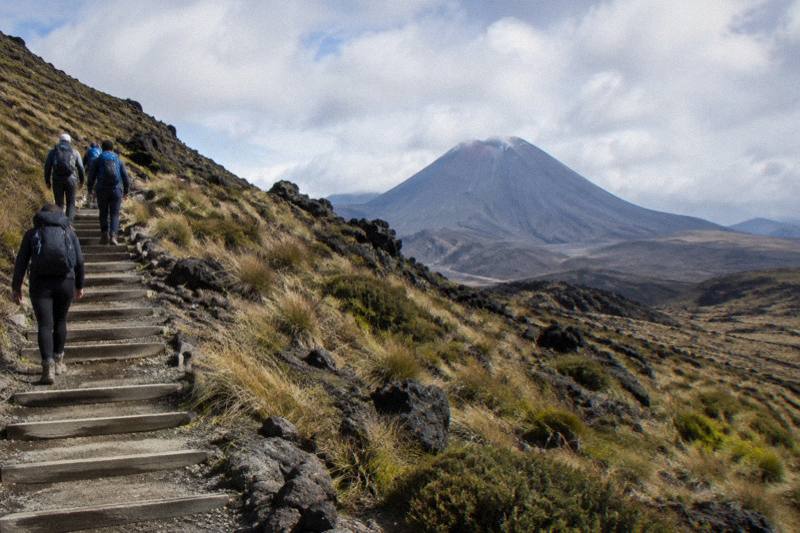
Tongariro Alpine Crossing Winter Guided Tour: Crampons, Ice Axes And Snow Guides
From May to late October the Crossing becomes an Expert route: snow, ice and short daylight. Here is what a guided winter day actually involves, what the guides supply, and what it costs.
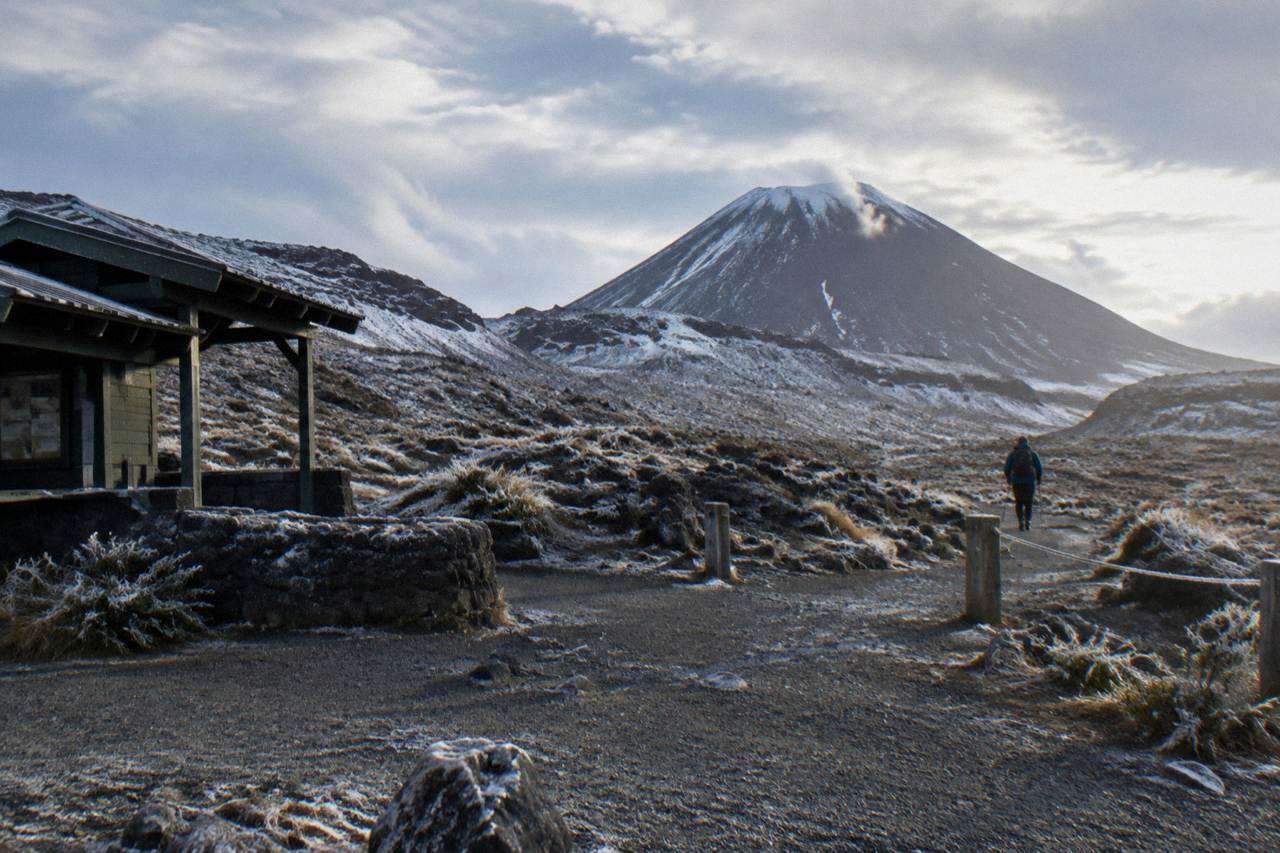
Short answer
The Tongariro Alpine Crossing is a winter route from May to late October: DOC grades it Expert, expects 9 hours of walking within 9 to 11 hours of daylight, and calls crampons, ice axe and helmet essential. Adrift Tongariro runs guided hikes across both seasons, from $253 per person, with crampons and ice axes supplied if conditions require.
Can You Do The Tongariro Alpine Crossing In Winter?
Yes, but only as a genuine alpine undertaking. From May to late October the Department of Conservation classes the Crossing as an Expert route, with snow, ice, avalanche risk and sub-zero temperatures, and recommends going with a guide. Walking time stretches to around 9 hours inside a window of just 9 to 11 hours of daylight, and a head torch is standard kit even for a day walk.
Winter here is not the summer track with a jacket added. DOC's own winter guidance is blunt about who the season suits: people with alpine skills, equipment and experience, who can navigate when cloud or snow hides the marker poles, read avalanche terrain, arrest a slide on ice, and survive weather that worsens mid-route. For everyone else, the same sentence finishes with four words that carry real weight: go with a guide.
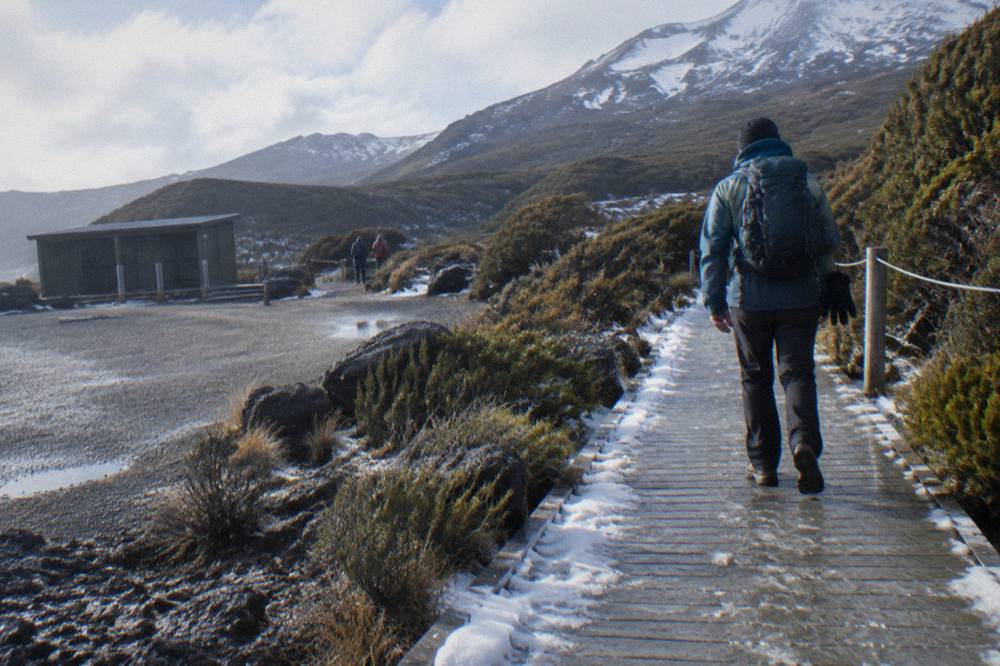
That framing matters because it shapes every decision on this page. A winter guided tour is not a scenic add-on to a summer itinerary; it is a guided alpine day on an active volcanic ridge. Adrift Tongariro, which runs the guided walks on this site, supplies crampons, ice axes and helmets when winter conditions require them, with clothing and boots available to hire, and a private walk cancelled for weather can be moved to a new date or fully refunded.
The good news for a reader researching this in the shoulder months: there is no separate winter product to hunt for. Adrift Tongariro runs the three guided tours on this site, and all three are listed for summer and winter alike. Winter equipment is supplied by the operator if conditions require it, which removes the hardest part of independent winter planning, hiring and knowing how to use the kit. The rest of this guide walks through what changes, what it costs, and how to judge whether a guided winter day is right for you. If you are still weighing the seasons generally, the month-by-month detail in which month suits the Crossing best is the natural companion read.
Why A Guide Matters On The Winter Crossing
A guide replaces the three things winter removes: transport, judgment and equipment know-how. DOC says shuttle buses generally do not operate from May to late October while guided trips include transport, and the same page advises alpine competency that most visitors simply do not have. On the high ridge, loose scree under snow and hidden marker poles turn a navigation task into a safety decision, which is exactly what a trained guide is there to make.
Start with transport, because it is the first wall independent winter walkers hit. The summer rhythm of parking near one end and catching a shuttle from the other largely disappears in the colder months. A guided tour sidesteps the problem completely: all three Adrift Tongariro tours include return transport in the booked day, setting out from the Adrift base at 53 Carroll Street, National Park Village. One caveat the operator states itself: the private guided Crossing does not offer Whakapapa Village or Ohakune transfers in winter, so base yourself accordingly.
Then there is judgment. On a calm winter day, DOC's temperature rule of thumb puts Red Crater at least 10 °C colder than Taupo and 5 °C colder than the track start, and you subtract another 2 °C for every 10 km/h of wind. A mild valley morning can hide a ridge-top day of wind chill well below zero. Guides assess the weather, ice and avalanche conditions on the day, and they make the call on whether the day goes ahead. The route can be altered, and reaching the Ketetahi end is not guaranteed. No operator, guided or otherwise, runs onto the track on a day when the rules and forecast do not allow it.
Equipment is the third pillar. DOC lists crampons, ice axe and helmet as essential in the May to late October winter season, "as is competency using them", plus an avalanche transceiver, probe and shovel for independent winter trips. That is a serious shopping and skills list for a one-off visitor. The guided tours carry it for you: Adrift Tongariro states that crampons and ice axes are supplied for winter conditions if required, alongside a clothing and footwear allowance. You still need to arrive dressed for a sub-zero alpine day, but the technical kit and the knowledge of how to use it travel with the guide.
What The Adrift Tongariro Guided Tours Cost And Include
The full guided Crossing runs from $253 per person for a booked day of 8 to 9 hours, rated 4.6 across 241 reviews. A shorter guided half-day walk, which does not cover the full Crossing, runs from $197 per person, and a private guided Crossing over 7 to 9 hours is from $774.01. All three include return transport and winter equipment when conditions require it.
Those three figures are the guided picture for winter on this site, because Adrift Tongariro runs the three guided tours shown here. The comparison between them is really a comparison of commitment levels.
| Tour | Format | Booked day | From (USD) | Rating and reviews |
|---|---|---|---|---|
| Premium guided Crossing hike | Guided full Crossing, summer and winter | 8 to 9 hours | $253 per person | 4.6 across 241 reviews |
| Half-day guided walk | Guided shorter walk, not the full Crossing | 4 hours | $197 per person | 4.7 across 27 reviews |
| Private guided Crossing | Private guided Crossing | 7 to 9 hours | $774.01 | 4.5 across 30 reviews |
Read the middle row carefully before booking it for a winter summit day: the half-day guided walk is exactly that, a shorter guided walk, not the full Crossing. For a visitor who wants the volcanic high country but not a 9-hour winter undertaking, it is a sensible product. For a reader whose heart is set on Red Crater and the Emerald Lakes under snow, only the premium or private tours deliver the full track.
What the guided price buys, beyond the guide, is the logistics that winter makes otherwise difficult. Return transport is included on all three tours, departing the Adrift base at 53 Carroll Street, National Park Village, and the operator states hotel pickup is not included, so plan to make your own way to the base. Crampons and ice axes are supplied for winter conditions if required, together with a clothing and footwear allowance. Lunch is not included on any of the three, so bring your own food and 2 to 3 litres of water, because track water is not drinkable in any season.
Age and group terms differ tour by tour, and only where stated. The premium guided hike takes walkers from age 12 and runs to a maximum group of 60. The private Crossing is also from age 12, with no stated group maximum, and it is the one non-refundable guided product: the operator states the experience cannot be changed or refunded for any reason. The premium and half-day tours both allow free cancellation up to 14 days in advance for a full refund. DOC, separately, advises that the track is not recommended for children under 10. If a private winter day is the direction you are leaning, the private guided Crossing guide unpacks that product in detail.
What Winter Conditions And Gear Actually Look Like
Expect ice on the track between April and October, snow lying on the ridge through the winter season of May to late October, and sub-zero temperatures at the 1886 m high point even on calm days. DOC says 38 percent of tramping injuries come from slipping, which is why crampons, an ice axe and a helmet are listed as essential, with competency in using them treated as equally non-negotiable.
The winter track is the same 20.2 km one-way line as summer, from Mangatepopo at 1120 m up over Red Crater at 1886 m and down to Ketetahi Road at 760 m, with an elevation change of plus and minus 1196 m. What changes is the surface and the stakes. The boardwalked Mangatepopo Valley can hold ice from the first hour. The staircase climb of roughly 350 m to the South Crater plateau becomes a snow slope. Red Crater's loose scree, which DOC flags as a major slip hazard even in dry summer conditions, behaves like a gully of ball bearings when frozen. And the long zig-zag descent off the northern slopes, the section that can trouble weaker knees on a good day, demands even more from tired legs in winter.
| What changes | Summer, Nov to Apr | Winter, May to late Oct |
|---|---|---|
| DOC track grade | Intermediate tramping track | Expert route |
| DOC walking time | 7 to 8 hours | Allow 9 hours |
| Typical hazards | Steep, undulating terrain, loose scoria on Red Crater | Snow, ice, avalanche, sub-zero temperatures |
| Essential technical gear | Sturdy boots and warm layers | Crampons, ice axe, helmet, plus competency using them |
| Official weather advisory | Not Recommended Today advisory assessed each morning | No hazardous weather advisories issued |
| Shuttles | Shuttle network operating | Shuttles generally do not operate |
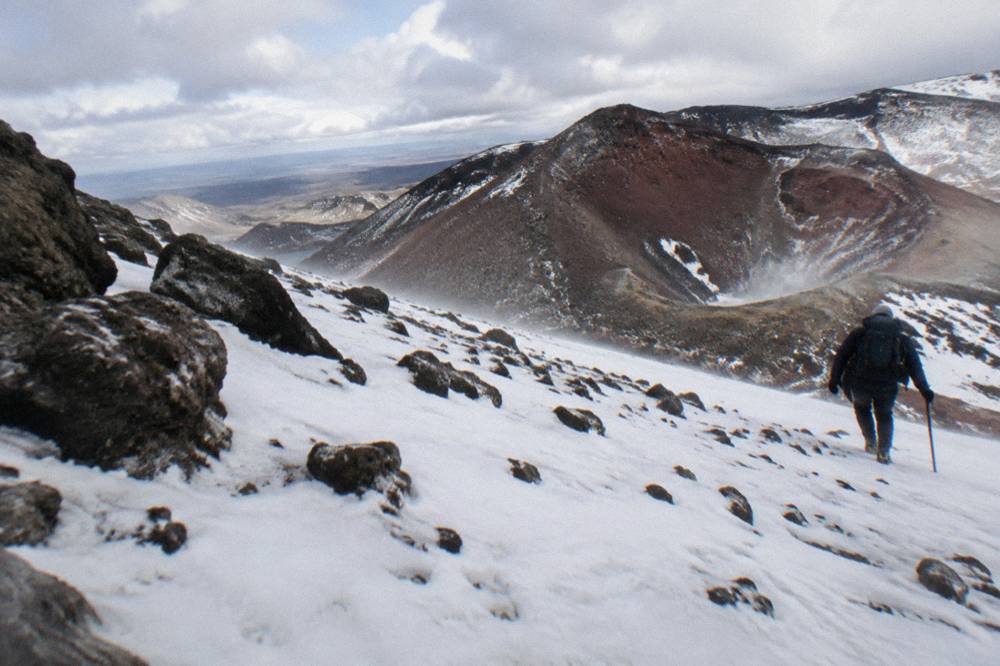
For an independent party, DOC's winter gear list is long: crampons, ice axe and helmet, an avalanche transceiver, probe and shovel, a personal locator beacon, a head torch with spare batteries, map and compass or GPS, waterproof jacket and trousers, gloves and hat, and sturdy tramping or mountaineering boots. Every item assumes the skill to use it under stress. A guided day transfers most of that burden: the technical equipment travels with the group, and the guide's competency stands in for yours. You still carry your own clothing layers, food, water and head torch, and the walk briefings treat boots as non-negotiable, which is why the operator's clothing and footwear allowance exists.
Two cultural rules apply on the winter track exactly as in summer, and they are worth repeating because snow makes them easier to break by accident. Ngati Hikairo ki Tongariro ask visitors to respect the sacred mountains by not touching or entering any waterways, including the alpine lakes. And the geothermal steam vents near the Emerald Lakes should never be approached, frozen ground or not. The full packing picture for a Crossing day is in what to bring on a Tongariro Alpine Crossing hike, with the winter additions noted separately.
How Long The Winter Crossing Takes
DOC says to allow 9 hours of walking for the winter Crossing, against 7 to 8 hours from November to April, inside a daylight window of 9 to 11 hours. The booked length of a guided day is a different number: the premium guided hike runs 8 to 9 hours door to door, and the private guided Crossing 7 to 9 hours. An early start is not a preference in winter, it is arithmetic.
The gap between walking time and booked duration confuses people, so it is worth spelling out. The 9-hour figure is DOC's estimate for the track itself, at winter pace, by people equipped for it. The booked tour duration includes the safety briefing, the equipment fitting, the drive to and from the road ends, and the buffer a guide builds in for a slow descent or a weather decision on the ridge. That is why the premium guided hike is listed as an 8 to 9 hour day, not because the walk gets shorter in a group.
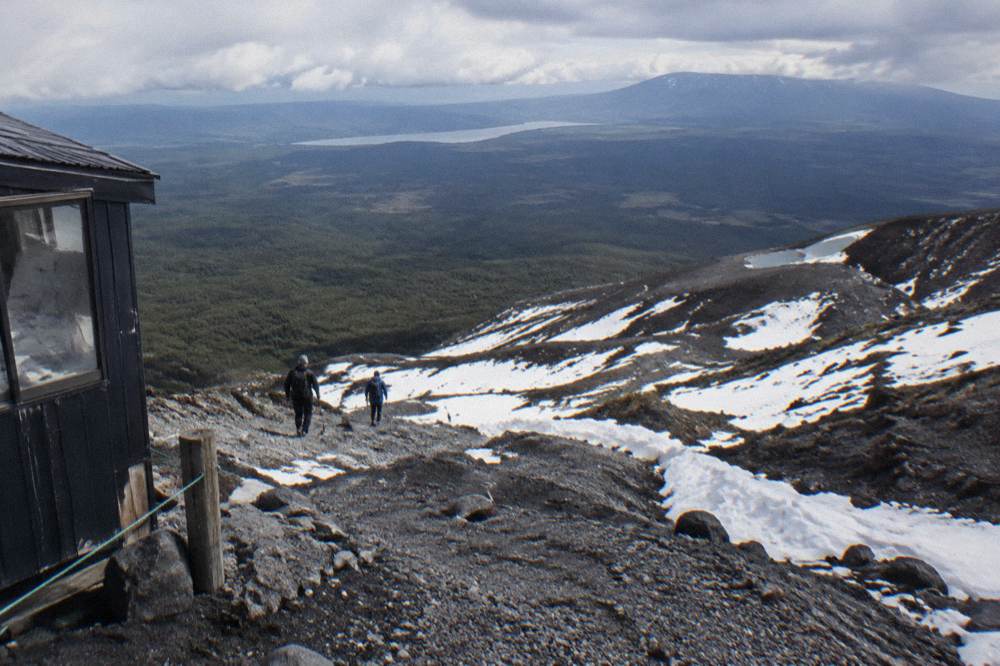
Daylight is the hard constraint. With between 9 and 11 hours of light in the winter months and 9 hours of walking to fit inside it, there is very little slack for a late start, a long lunch stop or an injury pause. This is the practical reason DOC says always take a head torch in winter, and it is also why guided winter days begin early and keep the group moving through the high section rather than lingering. The seasonal timing question, including how the shoulder months of April and October straddle the summer and winter gear lists, is covered in how long the Crossing takes.
Do Shuttles Run To The Crossing In Winter?
Generally, no. DOC states that shuttle buses generally do not operate during winter, from May to late October, while guided trips include transport. A handful of shuttle products list winter season notes, but the reliable winter pattern is a guided day with transport built in, not an independent walk stitched together from shuttle seats.
The summer shuttle economy exists because of a summer parking squeeze: from Labour weekend in late October to 30 April, DOC applies a 4-hour maximum at the Mangatepopo and Ketetahi road ends, says there is no summer Crossing parking at Mangatepopo car park, and suggests booking a shuttle. When the season turns, most of that network stands down, and the few services that keep running are sparse enough that a winter itinerary should not be built around them. The shuttle-versus-guided trade-off in the warm months, including the park-and-ride pattern of parking at the Ketetahi end and riding to Mangatepopo, is laid out in the car park or shuttle decision guide.
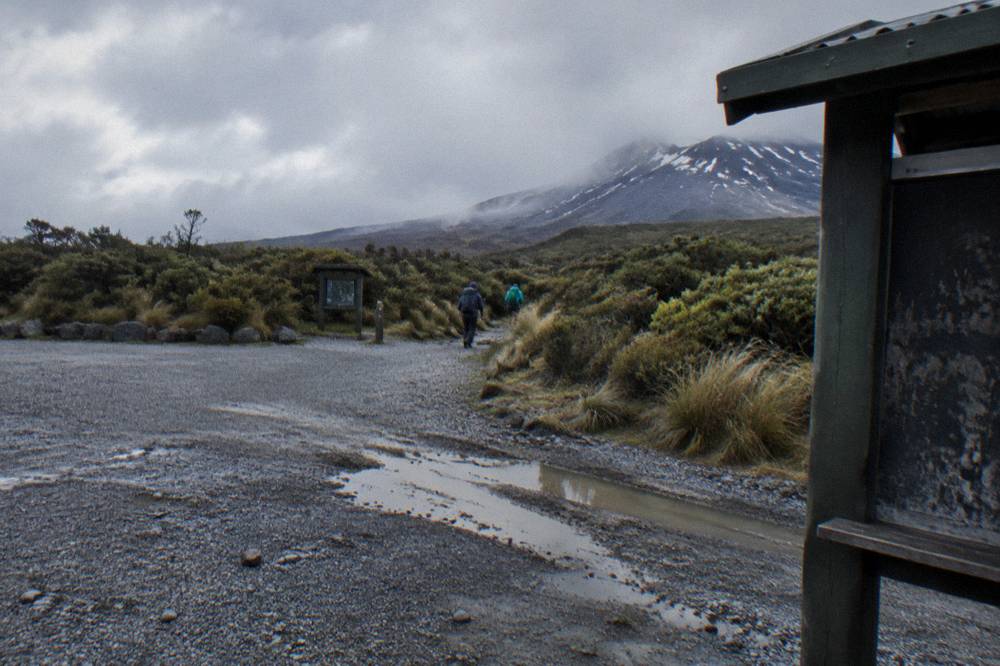
For a winter reader, the practical takeaway is simpler than the summer one. If you want to walk the Crossing between May and late October, the transport answer and the safety answer point to the same product: a guided tour that includes return transport. The premium guided hike from $253 per person and the private guided Crossing both cover it, and the round-trip transport included in those bookings replaces the shuttle decision entirely.
One planning note for anyone coming from further afield in the cold months. The long-distance products on this site, the private transfer from Auckland and the private three-day tour from Auckland, treat the Crossing differently: the transfer excludes the Crossing shuttle and the walk is self-guided, while the three-day tour includes the Crossing as one self-guided leg among Waitomo, Huka Falls and Lake Taupo stops. Neither is a guided Crossing day, so neither answers the winter safety question this page is about. The Auckland options are compared properly in getting to the Crossing from Auckland.
Weather, Advisories And Checking Winter Conditions
In winter nobody issues a go or no-go advisory. DOC's summer Not Recommended Today advisory runs on the NIWA Red Crater forecast and is assessed each morning, but no hazardous weather advisories are issued from May to October, so the forecast reading falls to you or, on a guided day, to your guide. The sources to know are the DOC Tongariro page and alerts, NIWA's Red Crater forecast, the MetService mountain forecast, GeoNet and the avalanche forecast.
The summer advisory, for contrast, triggers when any two hours between 9 am and 5 pm show average wind of 55 kph or more, gusts of 70 kph or more, wind chill at or below minus 10 °C, wind chill at or below 0 °C with 1 mm or more of precipitation, rain at 2.5 mm per hour or more, snow at 0.1 cm per hour or more, or 10 mm of precipitation over six hours. It is a well-defined threshold system, published on signage at the Mangatepopo road end and emailed to operators. In winter that machinery is switched off. The mountains do not become safer; the official daily verdict simply stops being produced, which is a large part of why DOC's winter advice leans so heavily on alpine competence and on going with a guide.
Winter bookings carry the same honesty in reverse: a day can look perfect from National Park Village and be ruled out by ridge wind chill, or vice versa. Checking the volcanic picture matters too. The Crossing traverses an active volcanic area, the hazard zone is a 3 km radius around each of the three Tongariro vents, and if volcanic activity levels rise at Tongariro or Ngauruhoe, DOC closes tracks or sections accordingly. The most recent eruption from Te Maari was in 2012. The standing sources are DOC's Tongariro Alpine Crossing page and its alerts, the Department of Conservation's official Tongariro information, and for the snow and avalanche picture, the New Zealand avalanche forecast for the Tongariro region.
Booking, Ages And Cancellation Terms For A Winter Tour
The premium guided Crossing runs from $253 per person, from age 12, in groups up to 60, with free cancellation up to 14 days before for a full refund. The private guided Crossing, also from age 12, is non-refundable and cannot be changed, and the half-day walk carries the same 14-day free cancellation; check the booking page for the age rule. DOC's free track booking system is required to use any shuttle or guided service.
Since October 2023 the Crossing has had a free booking system: recommended for everyone using any part of the track, required if you are using a shuttle or a guided walk service, with no cost, no cap and no penalty for arriving without one. One booking covers a group, the receipt is shown to rangers at the carpark, and the guide or shuttle operator may make the booking for you. Ask your operator at the time of booking rather than assuming either way.
| Tour | Min age | Group size | Cancellation |
|---|---|---|---|
| Premium guided Crossing hike | 12 | Up to 60 | Free up to 14 days before, full refund |
| Half-day guided walk | Check the booking page | Check the booking page | Free up to 14 days before, full refund |
| Private guided Crossing | 12 | Private | Non-refundable, cannot be changed |
The refund row deserves a second read before you pay. The private guided Crossing is the one guided product on this page where the operator states plainly that the experience is non-refundable and cannot be changed for any reason, and the booking page shows the cancellation terms for every tour. Winter sharpens this: weather calls are made close to the day, and a non-refundable booking that cannot move dates carries real risk in a season defined by changeable conditions. The 14-day cancellation window on the premium and half-day tours is generous by comparison, but note that it is 14 days, not the 24 hours common among summer shuttle products.
For walkers comparing the guided winter day against a self-guided one in the same season, the honest summary is that the comparison is rarely close. An independent winter Crossing needs the full DOC equipment list, avalanche awareness, navigation in whiteout conditions and a transport answer in a season when shuttles generally do not run. A guided day supplies the guide, the technical equipment, the transport and the weather judgment in one package. The case for and against a guide in general is argued in can you hike Tongariro without a guide, and the winter answer is the summer answer with the dials turned up.
Choosing Between The Guided Winter Options
Choose the premium guided hike from $253 per person for the full winter Crossing with a group and a guide; choose the private guided Crossing from $774.01 when you want your own group and pace, accepting non-refundable terms; and reserve the half-day guided walk from $197 per person for winter volcano scenery without a 9-hour commitment. All three run summer and winter with return transport included, and none of them guarantees the walk goes ahead.
The full Crossing in winter is a 9-hour alpine day on a graded Expert route, and DOC rates the fitness requirement High even in summer. A walker who would comfortably manage the summer track may find the winter version, with slower snow travel and a colder, heavier pack, a different proposition entirely. The half-day guided walk exists partly for exactly that person, and the first 5.4 km of the track, shared with the easy Soda Springs Walk, gives a guide a natural turnaround point on a hard day.
Base yourself where the tour starts. All three guided tours depart the Adrift base at 53 Carroll Street, National Park Village; none of them includes hotel pickup, so the practical addresses matter. By DOC's distances from the track, Whakapapa sits 10.4 km away, National Park 13.5 km, Turangi 36.7 km, Ohakune 48 km and Taupo 86.5 km, and remember the private tour's note that Whakapapa Village and Ohakune transfers are not offered in winter. The wider set of departure towns and shuttle products, useful for the summer leg of a longer trip, is mapped in Crossing tours by departure town.
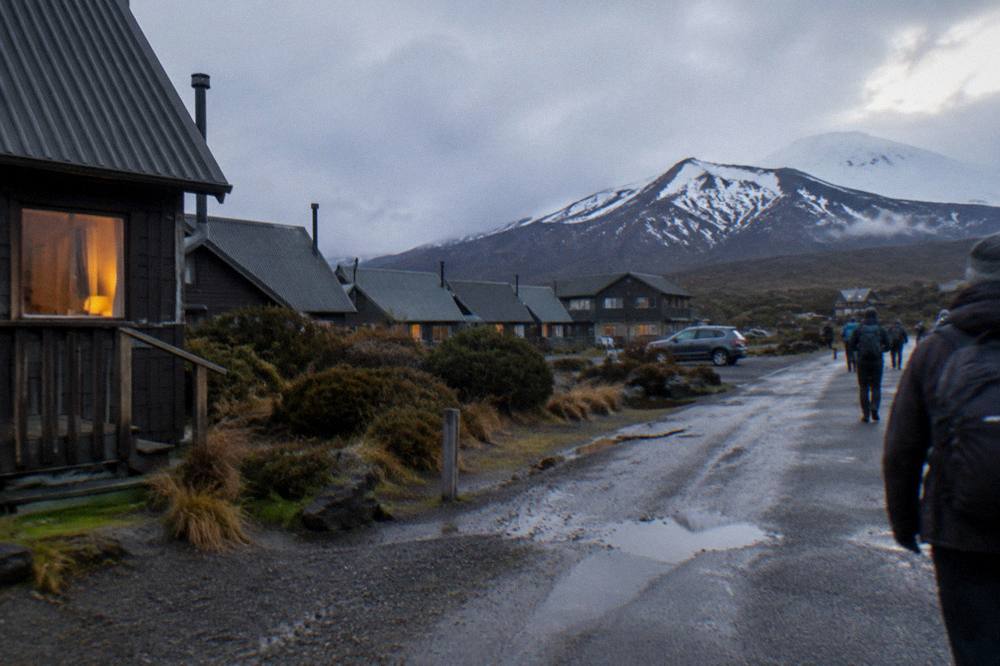
Whatever you book, hold the winter mindset lightly and the booking firmly. The mountains here are sacred to Ngati Hikairo ki Tongariro of Ngati Tuwharetoa inside New Zealand's oldest national park, created in 1894 and a dual World Heritage area, and a winter crossing done properly is one of the more demanding day walks available to a visitor. Done with a guide from Tongariro Alpine Crossing Tours' featured operators, it is also one of the more supported.
Common Questions About Winter Tongariro Crossing Tours
Can You Do The Tongariro Alpine Crossing In Winter?
Yes, as an Expert-graded alpine route. DOC's winter season runs from May to late October, expects around 9 hours of walking, and calls crampons, an ice axe and a helmet essential, along with the competency to use them. Guided tours run across both seasons, with crampons and ice axes supplied if winter conditions require them.
Is The Winter Crossing Harder Than Summer?
Markedly. DOC grades the track Intermediate from November to April and Expert from May to late October. Snow, ice, avalanche risk, sub-zero ridge temperatures and 9 to 11 hours of daylight all compress the margin for error, and the agency advises going with a guide in winter.
Do Shuttles Run To The Crossing In Winter?
Generally not. DOC states that shuttle buses generally do not operate during winter, from May to late October, while guided trips include transport. All three Adrift Tongariro guided tours include return transport from the base at 53 Carroll Street, National Park Village.
What Gear Does A Guided Winter Tour Supply?
On the Adrift Tongariro guided tours, crampons and ice axes are supplied for winter conditions if required, together with a clothing and footwear allowance. Lunch is not included, so bring your own food plus 2 to 3 litres of water, and carry a head torch, which DOC advises for winter regardless of guide.
How Much Does A Winter Guided Crossing Cost?
The premium guided full Crossing is from $253 per person for an 8 to 9 hour booked day. The guided half-day walk, which is not the full Crossing, starts from $197 per person. The private guided Crossing runs from $774.01.
Can I Cancel A Winter Guided Tour If The Weather Is Bad?
It depends on the tour. The premium guided hike and the half-day walk allow free cancellation up to 14 days in advance for a full refund. The private guided Crossing is non-refundable, but if the operator cancels for poor weather you get a new date or a full refund, and the booking page shows the cancellation terms for each product.