What To Bring On A Tongariro Alpine Crossing Guided Hike
Packing for the Tongariro Alpine Crossing means preparing for an alpine day at altitude, not a valley stroll. The Department of Conservation grades the fitness requirement High and the track Intermediate in summer, Expert from May to October, and the difference between the two seasons changes almost everything in your pack.
Short answer
DOC's day-hike advice for the 20.2 km Crossing is to carry 2 to 3 litres of water; sturdy boots, waterproof layers, hat, gloves, sunscreen and layered clothing are also standard kit for a walk of this length. Winter adds crampons, an ice axe, a helmet, avalanche gear, a head torch and navigation tools. On the three Adrift Tongariro guided tours, winter equipment and a clothing and footwear allowance are supplied, but bring your own lunch.
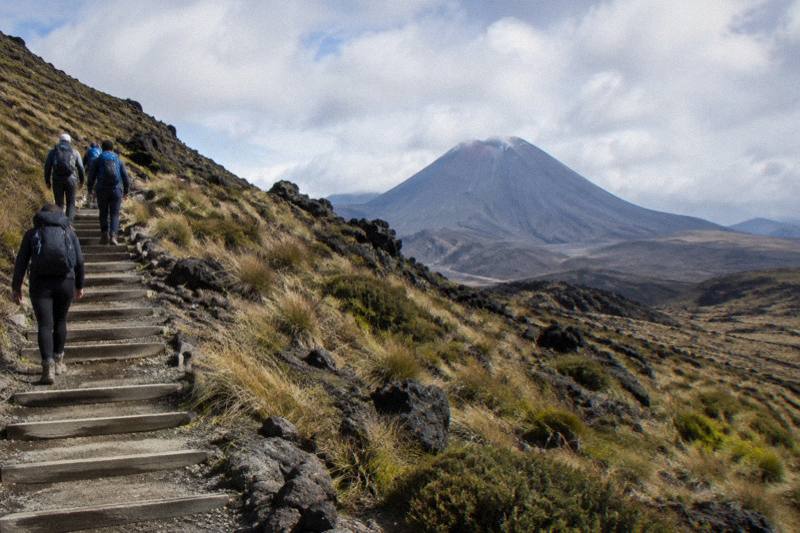
The Tongariro Alpine Crossing climbs from 1120 m at Mangatepopo to Red Crater at 1886 m and finishes near Ketetahi Road at about 760 m, a total elevation change of plus and minus 1196 m according to the Department of Conservation. That profile is the reason the packing list matters more here than on almost any other day walk in New Zealand. You cross an alpine environment with an active volcanic history, loose scree, exposed ridgelines and weather that can turn without much warning, all on a track DOC says takes 7 to 8 hours between November and April and 9 hours from May to October.
DOC calls the fitness requirement High and the gradient steep and undulating. The track water is not drinkable, the loose rock on Red Crater is a documented slip hazard, and on a calm day the summit area runs at least 10 °C colder than Taupo. Every item in this guide traces back to DOC's own guidance for the track, with one practical layer added: what changes if you book a guided tour rather than walking independently, because the three Adrift Tongariro guided options supply winter equipment and a clothing allowance that independent walkers have to source themselves.
What Should You Pack For The Tongariro Alpine Crossing?
For a summer Crossing, DOC's day-hike list comes down to 2 to 3 litres of water, sturdy boots, waterproof jacket and trousers, a warm hat and gloves, sunscreen, and a layered clothing system of base layer, insulation and shell. The track is 20.2 km one way with no drinkable water, so the water you carry is the entire day's supply, and the alpine sections give no shelter from wind or sun. If you can carry all that yourself, the guide to hiking the Tongariro Alpine Crossing without a guide covers what DOC expects of independent walkers and when paying for a guide makes more sense.
The core of the list is unglamorous and worth repeating exactly. DOC recommends the standard day-hike gear list plus 2 to 3 litres of water, because there is no safe drinking water along the track. Sturdy boots matter more than anything else you wear: the climb to South Crater runs up long staircases, the Red Crater section crosses loose scree, and DOC notes that the many steps on the descent can trouble weaker knees. Footwear with a firm sole and real ankle support does quiet work all day.
Waterproof layers are not optional even on a forecast fine day. DOC warns that the weather at Red Crater can be dramatically colder than the start, and that wind strips heat fast: their working rule is to subtract another 2 °C for every 10 km/h of wind. A shell jacket and trousers that fit over your insulation layers are the cheapest insurance on the mountain. Sun protection belongs on the list for the same reason: much of the route is above the bushline with no shade, and the eroded volcanic ground reflects heat and glare.
The clothing system deserves a sentence of explanation. Layers work because you will be hot on the Mangatepopo valley boardwalk and the Devil's Staircase, and cold within minutes on the South Crater plateau or the exposed ridge to Red Crater. A moisture-wicking base layer, a warm mid layer you can strip off, and a wind-and-waterproof shell let you match the mountain as it changes around you, which it does repeatedly across the 20.2 km. Cotton has no place in any of the three layers.
Here is the full summer list in one place, drawn from DOC's guidance for the track:
| Item | Why DOC lists it | Notes for the Crossing |
|---|---|---|
| 2 to 3 litres of water | Track water is not drinkable | No refill points along the 20.2 km |
| Sturdy boots | Steep, undulating, rocky track | Ankle support helps on scree and steps |
| Waterproof jacket and trousers | Alpine weather changes fast | Fit them over insulation layers |
| Warm hat and gloves | Red Crater runs far colder than the start | Subtract 2 °C per 10 km/h of wind |
| Sunscreen | Long sections above the bushline with no shade | Volcanic ground reflects glare |
| Base layer, insulation, shell | Temperature swings across the route | Skip cotton entirely |
How Much Water And Food Should You Carry On The Day?
Carry 2 to 3 litres of water per person, the amount DOC specifies for the track, and plan a full day's food including lunch, because the three Adrift guided tours on this site do not include lunch in their price. Toilets sit roughly every 1 to 2 hours along the route, and if there is a queue at Mangatepopo the next toilets are 1 km, about 20 minutes, further on.
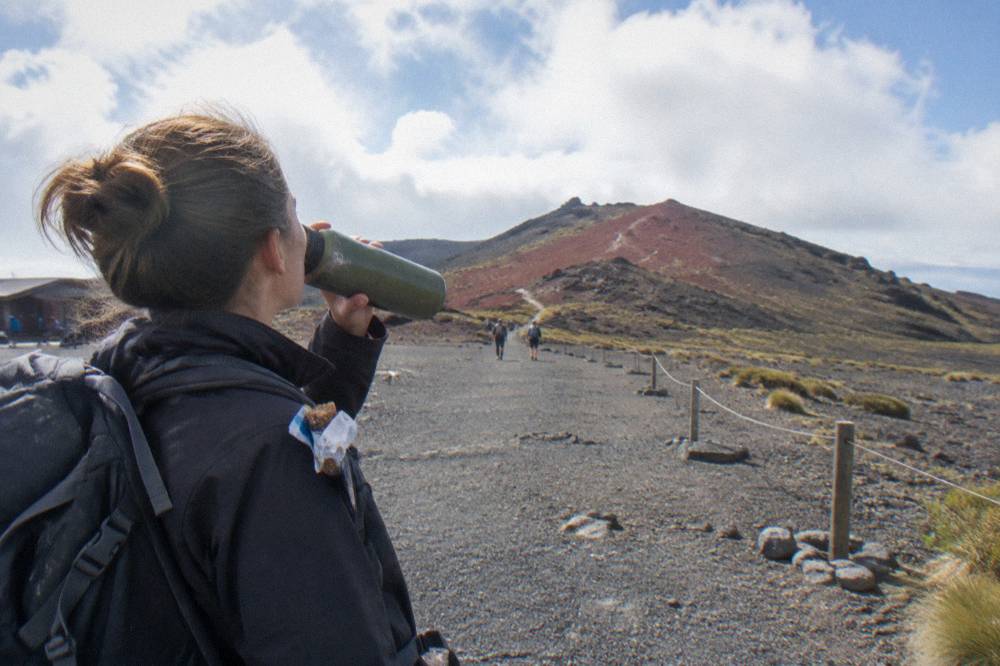
Water is the single most common packing failure on the Crossing. There is nowhere to top up, the walking day is long by any standard, and the exposed middle sections of the route dehydrate people faster than they expect. Three litres is the right planning number for a warm day; two is the floor, not the target. A bladder with a hose tends to get drunk more consistently than bottles, but bottles are easier to monitor, so pick whichever system you will actually use across 7 to 8 hours of walking in the November to April season.
Food is the second half of the equation, and here a specific point matters for guided walkers: none of the three Adrift Tongariro guided tours includes lunch, so the instruction is simply to bring your own. Plan a proper lunch plus high-energy snacks you can eat while moving, because the Red Crater climb and the long northern descent both reward a steady intake rather than one big stop.
The toilet spacing shapes your rhythm more than most people expect. DOC places toilets every 1 to 2 hours of walking, with the specific note that a queue at Mangatepopo means the next facilities are 1 km on. That knowledge removes the guesswork from fluid intake: you can drink properly rather than rationing out of uncertainty. Rubbish packing follows the same logic, since the cultural guidance for the park asks visitors to take all rubbish home, part of the respect Ngati Hikairo ki Tongariro ask of everyone walking their sacred maunga.
If you are weighing a guided day against going alone with a shuttle, the arithmetic of what is supplied differs sharply. Adrift Tongariro runs three guided tours: the premium guided Crossing hike from $253 per person, rated 4.6 across 241 reviews, the half-day guided walk from $197 per person, rated 4.7 across 27 reviews, and a private guided Crossing is from $774.01. The Tongariro Crossing Shuttles round-trip from National Park Village, by contrast, is transport only from $42 per person, rated 4.7 across 886 reviews, and every gram of gear, food and water is yours to carry in yourself.
The choice between those formats is really a choice about how much of this packing guide applies to you. A shuttle walker owns every item on the list. A guided walker still brings lunch, water and personal layers, but hands the winter hardware question, and the judgment calls that go with it, to the operator.
What Winter Gear Does DOC Require For The Crossing?
From May to late October DOC treats the Crossing as an Expert route and lists crampons, an ice axe and a helmet as essential, with competency in using them, plus an avalanche transceiver, probe and shovel, a distress beacon, a head torch with spare batteries, and map and compass or GPS for anyone walking independently. Expect ice on the track between April and October, and allow 9 hours with only 9 to 11 hours of daylight.
Winter on the Crossing is a different activity, not a colder version of the summer walk. DOC's winter guidance states plainly that the track becomes an Expert route with snow and ice in sections, that 38% of tramping injuries come from slipping, and that the marker poles that define the summer line can be hidden by cloud or snow. Navigation tools are on the required list for exactly that reason: a map and compass or GPS, plus the skill to use them when the landscape stops giving you visual confirmation of where you are.
The avalanche equipment requirement deserves attention. For independent winter trips DOC expects a transceiver, probe and shovel, and the knowledge of where avalanches are a risk and how to rescue someone caught in one. Winter walkers are also directed to check the avalanche forecast before setting out, at avalanche.net.nz, because no hazardous weather advisories are issued from May to October the way they are in summer. In winter the forecast reading falls entirely to you.
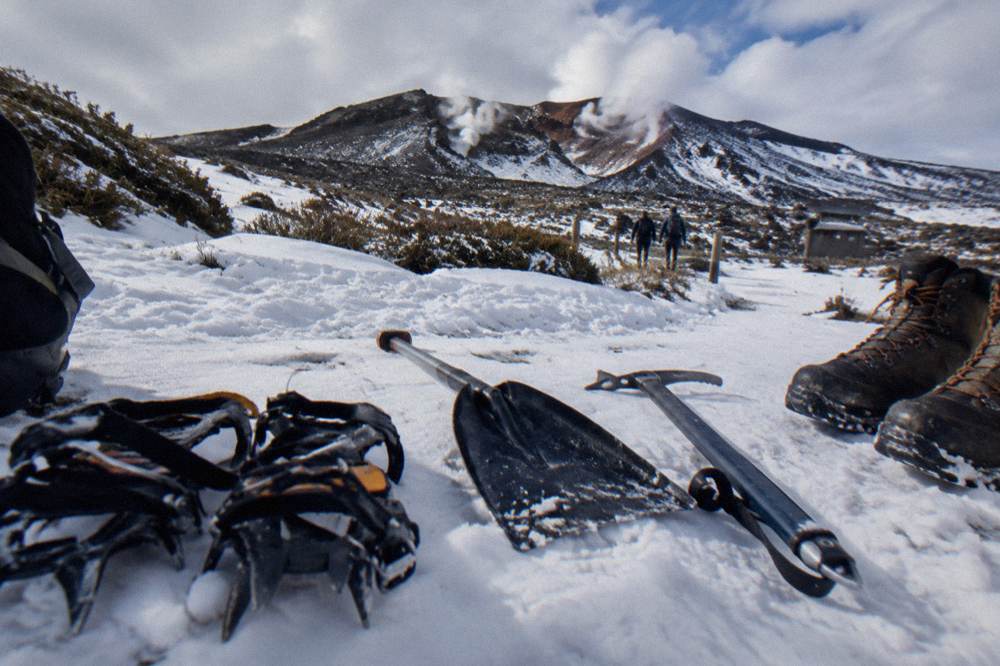
The daylight arithmetic explains the rest of the winter list. DOC says to allow 9 hours for the walk against 9 to 11 hours of daylight in winter, which leaves almost no margin for a late start or a slow section, and is why the head torch with spare batteries is essential rather than precautionary. Sturdy tramping or mountaineering boots, waterproof jacket and trousers, gloves and a hat round out the clothing side, and DOC's summary of who the winter track suits is worth reading literally: people with alpine skills, equipment and experience, closing with the short advice to go with a guide.
| Season | Track category | Key DOC requirements |
|---|---|---|
| November to April | Intermediate | Day-hike list, 2 to 3 L water, boots, waterproofs, layers |
| May to late October | Expert route | Crampons, ice axe, helmet, avalanche gear, PLB, head torch, navigation |
| April and October shoulder | Ice expected | DOC says expect ice on the track April to October |
For context on how the seasons shape the whole visit, the weather and tours guide explains the summer advisory system and the one condition, a Hazardous Weather Warning, under which operators have agreed not to run.
What Gear Does A Guided Tongariro Tour Actually Supply?
On the three Adrift Tongariro guided tours, crampons and ice axes are supplied for winter conditions when required, and each tour includes a clothing and footwear allowance, so the two heaviest winter decisions are handled for you. Lunch is excluded on all three, and hotel pickup is not included: the walks meet at 53 Carroll Street, National Park Village, return transport included, and the premium hike offers paid transfers from Taupo, Tūrangi or Whakapapa (minimum two).
This is where a guided booking genuinely changes your packing list, and it is worth being precise about the boundary. Winter hardware is the expensive, technical, hard-to-rent-well part of the DOC list: crampons that fit your boots, an ice axe sized to you, a helmet. On the Adrift Tongariro premium guided Crossing hike, the Adrift half-day guided walk and the private guided Crossing, that equipment is supplied for winter conditions if required, along with a clothing and footwear allowance whose amount the operator sets. The premium hike runs from $253 per person with a group maximum of 60 and a minimum age of 12, and the same minimum age of 12 applies to the private option. If your plans point to the warmer months instead, the guide to summer guided Crossing departures compares what each Adrift Tongariro option includes and requires once the snow has cleared.
What the tours do not cover is the human-fuel side of the day. Food and lunch are not included, so the water and food planning from earlier in this guide applies in full even on a fully guided day. Your own sturdy boots remain the foundation of the whole system, because supplied crampons still need a boot to attach to, and the 20.2 km of volcanic terrain under them does not soften because a guide is present. Guided or not, the Red Crater scree and the stepped northern descent are the same mountain.
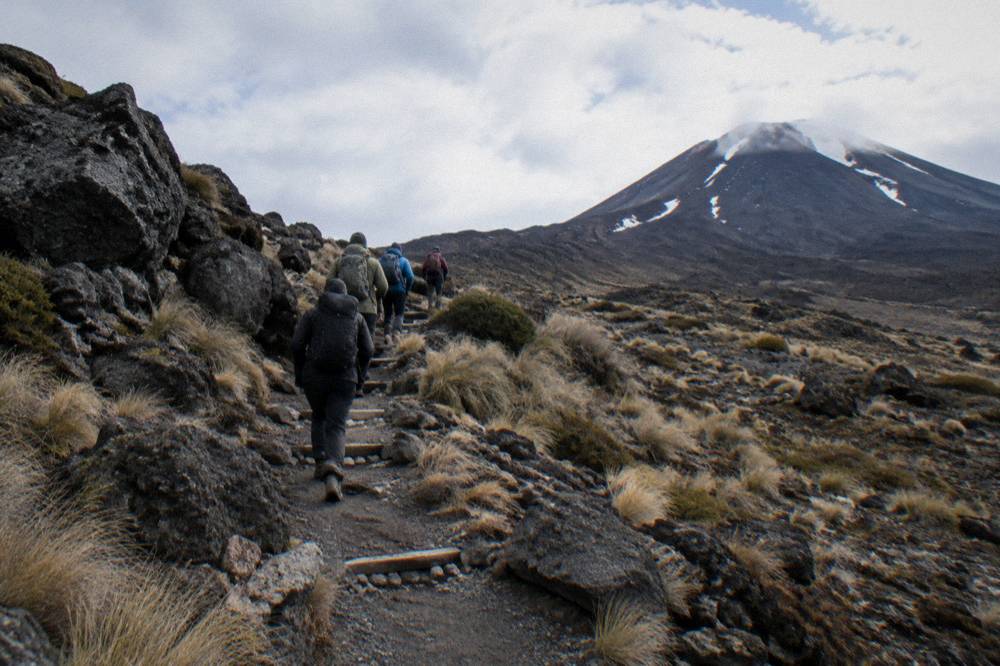
Guided transport also solves a problem that packing cannot. DOC notes that shuttle buses generally do not operate in winter, but guided trips include transport, and all three Adrift tours include return transport from the meeting base. In the November to April season that same convenience is available cheaply without a guide: the shuttle comparison from National Park Village covers the round-trip options, including the Tongariro Crossing Shuttles round trip from $42 per person and the Dempsey Buses round trip from $51 per person, rated 4.8 across 72 reviews.
One planning note for families: DOC advises the track is not recommended for children under 10, and operator age rules sit on top of that. The Adrift premium and private tours set a minimum age of 12, the National Park Shuttles one-way shuttle sets 8, and both Dempsey Buses services exclude children under 6. Check the tour's own terms when you book rather than assuming a site-wide rule, because each age limit belongs to its operator alone.
The half-day guided walk deserves a specific mention for uncertain walkers. It is a shorter guided walk, explicitly not the full Crossing, running 4 hours from $197 per person and rated 4.7 across 27 reviews, with the same winter equipment and clothing allowance as the full-day version. For someone unsure whether an 8 to 9 hour booked day suits their fitness, it answers the gear question and the distance question at once.
What Should You Wear On The Day Of The Crossing?
Wear a layered system you can adjust hourly: a moisture-wicking base layer, insulating mid layers, and a windproof and waterproof shell, with a hat, gloves and sturdy boots, because the route moves between a sheltered valley, an exposed 1886 m crater ridge and a long northern descent, and the temperature at Red Crater can be at least 10 °C colder than Taupo on a calm day.
The practical test of your outfit is whether you can add or remove a layer without stopping for long. The Mangatepopo valley and the staircase to South Crater generate heat; the crater plateau and the Red Crater ridge take it back with interest, especially once wind enters the equation. DOC's temperature rule gives you the scale: Red Crater runs at least 5 °C colder than the track start and at least 10 °C colder than Taupo on a calm day, before you subtract 2 °C per 10 km/h of wind. On a day that feels mild in town, the ridge can sit near freezing with wind chill. The rest of the planning pages sit on Tongariro Alpine Crossing Tours.
Footwear is the most consequential clothing decision, and it has its own following among walkers: the sneakers question comes up constantly, and the short answer is that DOC's sturdy-boots requirement exists because of the scree, the steps and the ice risk. If you are weighing that choice, the detailed look at footwear on the Crossing works through what the surface actually does to a soft shoe over 20.2 km. Below the boots, good socks and a small blister kit earn their space in the pack on a walk of this length; the descent in particular punishes toes pushed against boot fronts for hours.
| Layer | Job on the Crossing | Example |
|---|---|---|
| Base layer | Move sweat away from skin | Moisture-wicking top and leggings |
| Insulation | Hold warmth on the crater plateau | Fleece or puffer mid layer |
| Shell | Block wind and rain at altitude | Waterproof jacket and trousers |
| Extremities | Cover the fast-heat-loss points | Warm hat, gloves, sun hat |
| Feet | Grip and support over scree and steps | Sturdy boots, quality socks |
Sun protection rounds out the worn layer. Sunscreen, sunglasses and a sun hat belong in the pack even when the morning feels overcast, because most of the route is above the bushline and the dark volcanic rock radiates heat back up at you. The same sections that freeze your hands on the ridge can burn your neck an hour later on the descent, which is the alpine contradiction the whole layering approach is built to absorb.
How Does Your Packing Change With The Season And Your Transport?
In the November to April season your packing follows the day-hike list plus the parking rule, with DOC applying a 4 hour maximum at the road ends from Labour weekend until 30 April and suggesting a shuttle, while the winter kit list fully applies only from May to late October. Transport matters too: one-way park-and-ride shuttles mean walking back to your own car at the Ketetahi end, whereas round trips return you to your start point.
The seasonal split is clean on paper and deserves respect at the edges. Ice is expected on the track between April and October, so the shoulder months can demand winter traction even when the calendar says autumn or spring. If your trip falls in April, May or October, pack for the colder regime and check the forecasts before you decide it is a summer day. The sources to watch are DOC's Tongariro Alpine Crossing page and alerts, the NIWA Red Crater forecast, the MetService mountain forecast and avalanche.net.nz, which together cover the advisory triggers, the precipitation picture and the avalanche risk.
Transport shapes the logbook of your day as much as your legs do. The six one-way park-and-ride services, from the Ruapehu Scenic Shuttles and Owhango Adventures options at $38 per person through to the secure-parking services at $44.72 and below, share one pattern: you park at the Ketetahi end, ride to Mangatepopo, and the Crossing itself returns you to your car. Nothing about that changes your gear list, but it changes your logistics, because there is no return leg to catch and no time pressure other than daylight.
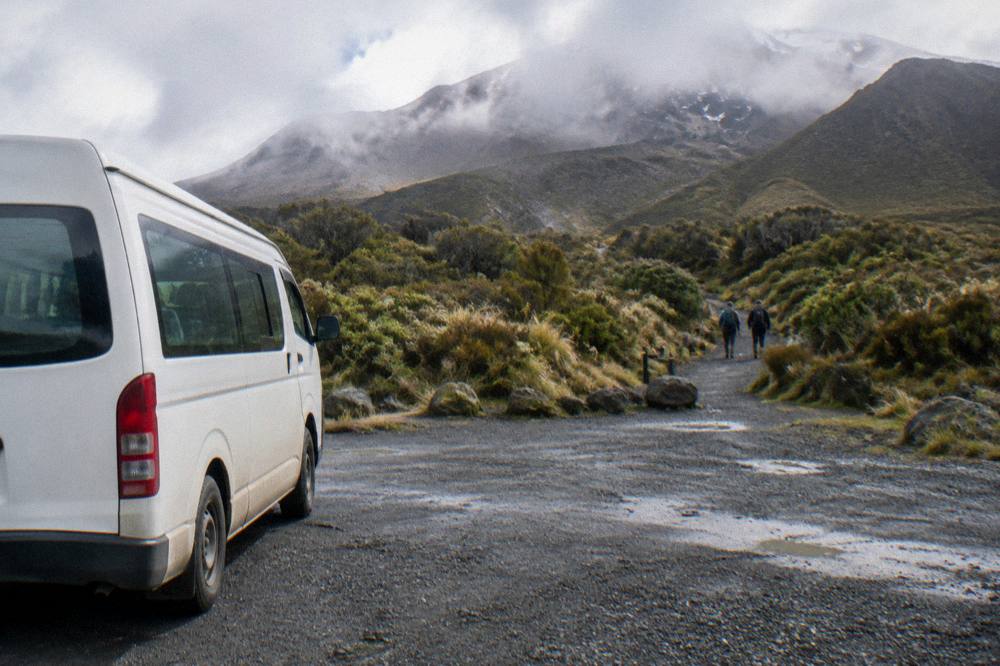
Round-trip shuttles invert that arrangement: you start from a village or town, ride to Mangatepopo, and an afternoon collection from Ketetahi closes the loop. The booking system that sits underneath all of this is free and straightforward, and the booking guide explains what a track booking covers and when you need one to use a shuttle or guided service. None of it costs anything, and rangers may ask to see the booking receipt at the carpark.
The free booking system was introduced in October 2023, is recommended for everyone, and is required if you are using a shuttle or guided walk; your guide or shuttle operator may make the booking for you, which is one more small item a guided day removes from your own packing-for-the-day checklist. Manaaki Rangers greet visitors daily from November to April at the track, and they are also the friendly face of the cultural rules that apply to what you carry: take your rubbish out, clean your gear, and never touch or enter the waterways, including the famous alpine lakes.
The Tongariro Crossing Shuttles round trip from National Park Village is the most reviewed tour here, rated 4.7 across 886 reviews, priced from $42 per person from the Park n Ride at 59 Findlay Street, with free cancellation up to 24 hours before. It pairs naturally with a self-sufficient pack: transport sorted, everything else on your own back.
What Extras Are Worth Adding To Your Pack?
Beyond the DOC core list, the additions that consistently earn their weight are a head torch regardless of season, a small first aid and blister kit, spare socks, a pack cover or liner, a power bank for the phone you are using as camera and map backup, and cash-free simplicity, since there is nothing to buy on the track. Every extra must justify itself against a 20.2 km carry, so multitaskers beat specialists.
The head torch illustrates the principle. DOC lists it as a winter essential with spare batteries, but on a 7 to 8 hour summer walking day that starts early, a delayed group or a slower-than-planned descent can push the final kilometres later than you planned, and a torch that weighs almost nothing converts that scenario from stressful to routine. The same logic covers a first aid kit built around blister care, because hot spots on the Devil's Staircase become problems on the descent if ignored, and the stepped northern section is where DOC notes knees suffer most.
Electronics deserve a deliberate choice rather than a default. A phone serves as camera, backup navigation and emergency communication, which makes a power bank the enabler for all three, but a phone is not a substitute for the map and compass or GPS that DOC expects in winter. If you are walking independently in the cold months, the paper and the beacon come first and the phone comes second. In summer with a guided group, the phone question reverses, and the power bank mainly keeps your camera alive to Red Crater and the Emerald Lakes.
A few small items round out a well-considered pack. A pack cover or liner keeps your spare layers dry even on a day that only threatens rain, because wet insulation is no insulation at all on an alpine ridge. Trekking poles help on the scree descent, though they are a preference rather than a DOC requirement. And a folded copy of your booking receipt, digital or paper, satisfies the ranger check at the carpark, a small administrative extra that closes the loop on a well-packed day. For everything that sits outside the pack, from hot pools to short walks near the track, the guide to free things to do around your Tongariro Alpine Crossing tour fills in the rest of the day.
For walkers who want the winter hardware question answered before it is asked, the Adrift Tongariro premium guided Crossing hike supplies crampons and ice axes when conditions require them plus a clothing and footwear allowance, runs 8 to 9 booked hours from $253 per person, is rated 4.6 across 241 reviews, and can be cancelled up to 14 days ahead for a full refund.
What Does The Mountain Itself Ask You To Carry Out?
The Crossing crosses mountains sacred to Ngati Hikairo ki Tongariro of Ngati Tuwharetoa, and the cultural request that reaches your packing list is simple: take all rubbish home, clean your shoes and gear, stay on the track, and do not touch or enter any waterways, including the alpine lakes. After the late 2025 fires near the track start, a 10 year restorative rahui by Ngati Hikairo ki Tongariro asks visitors to respect the recovering land without staying away.
This belongs in a packing guide because it is literally about what leaves in your pack. The fires of late 2025 burned significant areas of the park around the start of the Crossing, and the response from hapū was a rahui framed, in DOC's own words, as "not about keeping people out". Practically that means walkers stay on the formed track, keep out of fire-affected areas off track, arrive with clean shoes and gear to avoid spreading weeds and pathogens, and carry every scrap of rubbish back out with them.
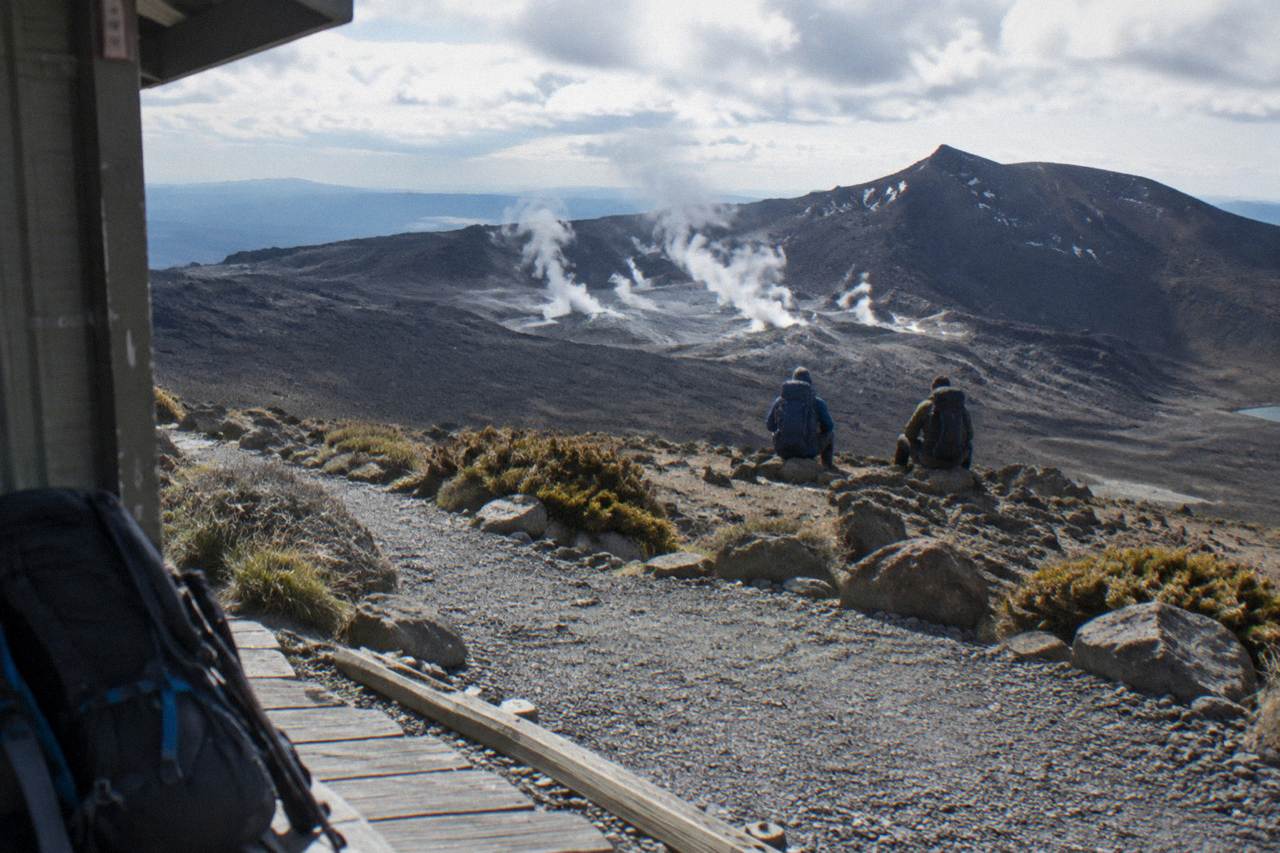
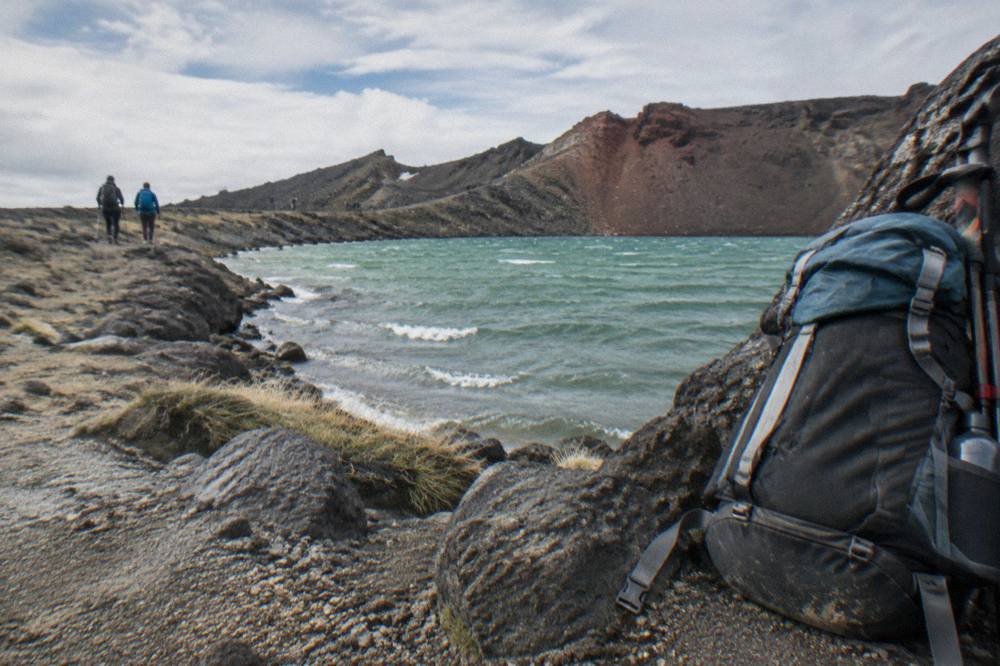
The waterways request is older and equally direct. Kaumatua Te Ngaehe Wanikau asks visitors to respect the sanctity of the sacred mountains by not touching or entering any of the waterways, including the alpine lakes, which is why the Emerald Lakes and Blue Lake are for the eyes and the camera, never for a swim or even a paddle. Geothermal safety reinforces the same line: fumaroles near the Emerald Lakes are hazardous, and DOC advises against approaching steam vents or touching the hot ground around them. For a fuller account of the mountain's story and its meaning, the overview Crossing guide covers the cultural landscape that earned Tongariro its dual World Heritage status, the country's oldest national park since 1894. For a closer look at the climb itself, the Devil's Staircase and Red Crater trail guide explains what each section demands.
None of this adds weight to your pack, but a spare bag for your rubbish, and the discipline to use it, is as much a part of a well-prepared Crossing as the boots on your feet. The mountain asks for very little: that you come prepared for it, and that you leave it exactly as you found it.
Common Questions About Packing For The Tongariro Alpine Crossing
What Should You Pack For The Tongariro Alpine Crossing?
DOC's list: 2 to 3 litres of water, sturdy boots, waterproof jacket and trousers, warm hat and gloves, sunscreen, and a base layer, insulation and shell system. Winter adds crampons, an ice axe, a helmet, avalanche equipment, a head torch and navigation tools.
Does A Guided Tour Supply The Gear?
The three Adrift Tongariro guided tours supply crampons and ice axes for winter conditions when required, plus a clothing and footwear allowance. Lunch is not included, and you still bring your own water, food, boots and personal layers.
How Much Water Do You Need?
DOC specifies 2 to 3 litres per person. Track water is not drinkable and there are no refill points across the 20.2 km route.
Do You Need Crampons In Winter?
Yes. DOC lists crampons, an ice axe and a helmet as essential from May to late October, along with competency using them, and expects ice on the track between April and October.
Can You Wear Sneakers On The Crossing?
DOC's guidance calls for sturdy boots because of the steep gradient, loose scree on Red Crater and stepped descent. Soft-soled shoes are a poor match for the terrain.
Should You Bring Lunch?
Yes. No tour on the mountain includes lunch, including the guided hikes, so pack a full day's food plus high-energy snacks for a 7 to 8 hour summer walking day.